
As the voluntary carbon market matures, the integrity of individual project types is under increasing scrutiny, and biochar is no exception. This framework sets out Residual's approach to evaluating biochar carbon credit quality across five primary considerations (Additionality, Carbon Accounting, Permanence, Environmental and Social Safeguards, and Delivery Risk) and two secondary ones (Co-Benefits and Scalability). Rather than a points-based scorecard, it is a qualitative tool designed to surface the questions that matter most before projects are mature and credits are issued. Whether you are a buyer, investor, or developer, this framework offers a principled lens for understanding where biochar credit quality is made or lost.
Biochar carbon credit quality, like any project type in the voluntary carbon market, is assessed across two dimensions: the credibility of the tonnes claimed, and the broader strategic value of supporting the project. Residual organizes the first into five main considerations (Additionality, Carbon Accounting, Permanence, Environmental and Social Safeguards, and Delivery Risk) and the second into two secondary considerations (Co-Benefits and Scalability). The relevant details within each of the considerations and its subsections vary by sector, and this framework outlines Residual’s focus when evaluating and designing biochar projects specifically.
The five main considerations assess whether the carbon credit represents a credible, durable, and responsibly delivered climate claim. Additionality asks whether the project, feedstock pathway, and biochar end-use would have occurred without carbon finance. Carbon Accounting assesses whether the quantification of the removal is complete, conservative, and supported by a defensible baseline-to-project comparison, including leakage, project emissions, and MRV integrity. Permanence evaluates whether the carbon stored in biochar is likely to remain out of the atmosphere over the claimed durability period, based on production conditions, biochar properties, end-use, and storage environment. Environmental and Social Safeguards assess whether the removal is delivered without material environmental or social harm, including pollution, toxicity, biodiversity degradation, or adverse impacts on Indigenous Peoples and local communities. Delivery Risk evaluates whether the project can realistically be financed, built, supplied with feedstock, operated, and monitored at the volumes committed.
Residual also considers two secondary considerations: Co-Benefits and Scalability. These do not determine whether a credit removes the tonnes of carbon dioxide equivalent claimed, but they do shape the broader value of supporting a project. Co-benefits can strengthen the project narrative and increase its relevance to buyers, communities, and other stakeholders, while scalability can create future access to larger credit volumes, potential cost efficiencies, and a credible role for investors in helping scale high-quality carbon removal.
This framework is methodology agnostic and applies primarily at the ex-ante stage, where many of the most important questions about project quality can already be assessed if the right evidence is available. This is particularly relevant to Residual, as we co-design and implement projects from early stages rather than assessing mature and issuing projects. The framework is also intended to help buyers, investors, and project developers identify where quality risks typically arise, what evidence should be requested, and how biochar projects can be designed to meet a higher standard of carbon credit integrity.
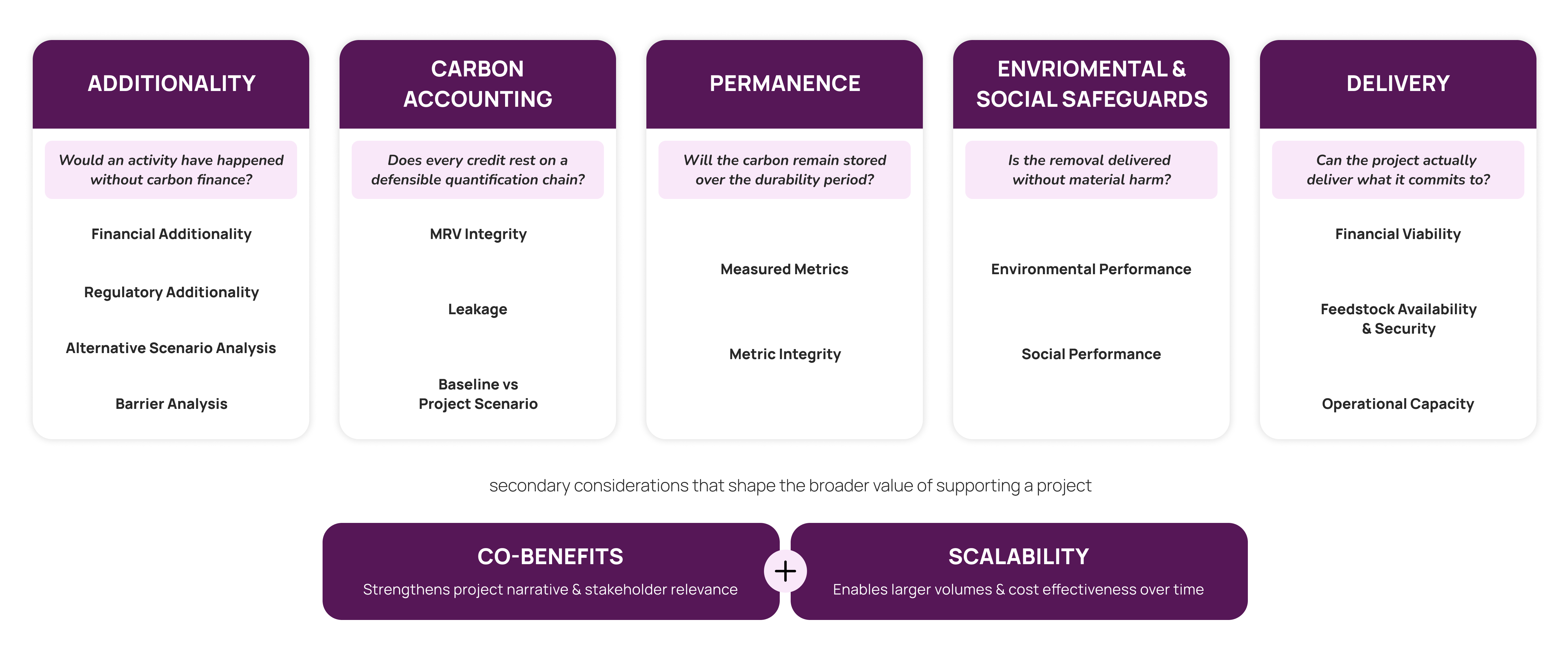
The framework serves three roles simultaneously. As a first-pass filter, it surfaces projects missing defensible substantiation on any pillar before deeper diligence begins. As a diligence tool, it gives the assessor a consistent structure for each dimension: the questions to ask and the features that indicate quality. As a public benchmark, it is an articulation of what we believe is required of high-quality biochar credits, against which project developers can hold their own work. The framework is qualitative by design. It does not operate as a points-based scorecard, and it does not resolve into a composite score; integrity is assessed by whether the evidence on each pillar stands up to informed scrutiny.
The time horizon over which a project commits to keep the stored carbon stored (for biochar, typically 200 or 1,000 years, depending on the durability claim). Distinct from the crediting period, which is the window over which a project can issue credits.
The length of time stored carbon is expected to remain out of the atmosphere. Biochar claims typically distinguish 200-year durability (supported by H/Corg and related stability indicators) and 1,000-year durability (supported by additional measures such as R0 and TGA).
The molar ratio of hydrogen atoms to organic carbon atoms in biochar. A lower ratio indicates a more aromatic, thermally stable structure. Standards such as the European Biochar Certificate and Puro.earth use an H/Corg cap (typically ≤ 0.7) as a proxy for long-term stability.
A structured quantification of greenhouse gas emissions and removals across the full chain of an activity, from feedstock production through end-of-life (cradle-to-grave). Biochar LCAs are conducted in line with ISO 14064-2 and form the backbone of the GHG accounting for a project.
A class of organic compounds that can form during pyrolysis and persist in biochar. Most biochar standards require PAH concentrations to be tested and kept below defined limits, given their potential toxicity to soil and water.
Closely related to durability: the condition under which stored carbon remains stored without reversal. Permanence risk covers both the intrinsic stability of the biochar and the continued integrity of its storage environment over the committed time horizon.
A petrographic measurement of how light reflects from biochar particles under a microscope. Higher R0 values indicate greater aromaticity and a more inertinite-like (highly stable form of carbon) structure; R0 is used alongside other indicators to substantiate 1,000-year permanence claims.
Written procedures that define how a facility is operated under normal and abnormal conditions. In biochar projects, SOPs cover feedstock tracking, pyrolysis operation, sampling, emissions management, and data recording and reporting; they are key evidence that claimed performance can be reproduced.
A term used in LCAs. Sources are processes or activities that release a GHG into the atmosphere; sinks are processes, activities, or mechanisms that remove a GHG from the atmosphere; reservoirs are components of the climate system other than the atmosphere, such as trees, soil, oceans, and underground geological formations, with the capacity to store, accumulate, or release GHGs. In biochar projects, the system boundary must account for all material SSRs in both the baseline and project scenarios.
A laboratory technique that measures a sample’s mass loss as it is heated. TGA profiles help characterise biochar composition, volatile content, and thermal stability, and form part of the evidence base for longer-duration permanence claims.
A 1-to-9 scale describing the maturity of a technology, from basic research (TRL 1) to proven commercial deployment (TRL 9). Biochar pyrolysis typically sits at TRL 7-8: operationally demonstrated, but not yet deployed at the scale implied by industrial-scale carbon removal.
Additionality is the foundational claim of any carbon project: that avoided emission or removals from the project activity would not have occurred in the absence of carbon finance. For biochar projects, this claim operates across three dimensions. Financial additionality establishes that the project economics depend on carbon revenue. Regulatory additionality establishes that the activity is not legally mandated. Alternative scenario analysis demonstrates that the chosen pathway is preferable to realistic counterfactuals. Together, these three dimensions constitute the additionality argument. Significant weakness in one of them undermines the integrity of the overall claim. The table below considers the aspects of additionality and the details required to prove integrity.
For biochar projects, financial additionality risk is primarily associated with the possibility that the project is already economically viable without carbon credit revenue. Although biochar facilities are often presented as carbon removal projects, many can also generate material revenues from the sale of biochar, heat, electricity, syngas, bio-oil, or other by-products, and some are built on top of existing industrial or charcoal-producing operations with sunk infrastructure and established markets. The main uncertainty, therefore, lies in whether carbon finance is truly decisive in overcoming the project’s capital costs, operating costs, and investment risks, or whether it merely improves returns for an activity that would have proceeded anyway. This risk is typically highest where biochar production is integrated into profitable pre-existing operations, where physical biochar demand is already established, or where subsidies and co-product revenues materially support the business model. In contrast, projects developed specifically for carbon removal in markets with weak standalone demand for biochar and limited alternative revenues are generally more likely to depend on carbon finance as a genuine enabling condition.
Regulatory additionality in the biochar sector is primarily affected by whether the credited activity goes beyond existing legal obligations. Risk arises where feedstock treatment, biomass removal, waste handling, air emissions controls, or land management practices are already required under applicable law, permitting conditions, or government policy. In these cases, the project may still deliver climate benefits, but those benefits would not qualify as additional if they would have occurred anyway as part of regulatory compliance. The central assessment is therefore whether carbon finance supports a genuinely voluntary action that exceeds baseline legal requirements, rather than simply monetizing an activity already mandated by the jurisdiction.
Alternative scenario analysis in the biochar sector depends on whether the project has considered the plausible, locally relevant counterfactual uses for the feedstock and provided credible evidence for rejecting them. The main risk is that an alternative pathway - anaerobic digestion, composting, or waste-to-energy, for example - would deliver greater environmental benefit than biochar for the feedstock in question. The chosen scenario should be the most environmentally positive option that remains financially feasible.
Carbon accounting assesses the integrity of the quantification and measurement system that underpins every credit a project issues. A project can have a strong additionality case and deliver genuine climate benefit but still issue low-quality credits if its monitoring, quantification, and verification systems are weak. The table below considers the aspects of carbon accounting and the details required to prove integrity.
MRV integrity depends on whether the project has a complete, consistent, and reproducible system for tracking emissions and removals across the full production chain. Three risks recur: system boundaries defined inconsistently across documentation; omitted material emission sources, including feedstock collection, pre-processing, transport, process energy, by-product handling, application, and non-CO2 pyrolysis emissions; and monitoring procedures too weak to support the LCA. High-integrity MRV practice therefore includes a clearly documented monitoring plan, continuous tracking of key operating parameters such as pyrolysis temperature and residence time, written SOPs covering both normal operations and malfunctions, justified treatment of immaterial sources and co-allocation, and transparent calculations that an independent reviewer can reproduce from the disclosed activity data, emission factors, and QA/QC procedures.
Leakage risk is primarily associated with the possibility that biomass diverted into the project causes emissions outside the project boundary, through market, activity displacement, or ecological channels. Market leakage arises where feedstock that would otherwise have supplied energy, composting, soil incorporation, or other productive uses is redirected to biochar production, shifting demand toward more emissions-intensive substitutes elsewhere. Activity displacement leakage arises where project feedstock production or sourcing displaces a pre-existing land use or economic activity beyond the project area. Ecological leakage arises where biomass extraction alters surrounding nutrient cycles, residue availability, soil cover, or wider ecosystem dynamics in ways that reduce carbon stocks or ecosystem function outside the project boundary; the effects can also be positive, including improved land management, soil health, and reduced GHG soil emissions, although projects are not credited for positive leakage. Leakage assessment in this sector therefore depends on identifying plausible offsite effects, quantifying them conservatively where material, and applying appropriate deductions or safeguards so that credited removals are not overstated.
Baseline and project scenario risk is primarily associated with whether the credited comparison is built on a realistic, evidence-based counterfactual and a complete accounting of project emissions. The baseline should reflect current practice in the project region, supported by documentary evidence such as official statistics, field surveys, peer-reviewed literature, attestations, or other local data, rather than generic assumptions about decomposition, burning, or alternative biomass use. On the project side, risk arises where direct or indirect emissions are omitted; the relevant sources include feedstock transport and pre-processing, process energy, by-product handling and disposal, biochar transport, application-stage emissions, and embodied emissions from materials, consumables, and infrastructure. Where multiple biochar end uses are envisaged, each pathway should be documented separately and assessed through scenario-specific permanence and LCA assumptions, so that credited removals are not overstated.
Permanence assesses the durability of the carbon storage that underpins a project's climate claim. A project can be additional and quantify removals accurately, yet still issue low-quality credits if the stored carbon is likely to return to the atmosphere before the claimed storage period ends. Permanence risk depends on the stability of the carbon storage pathway, the likelihood of physical or biological reversal, the suitability of the end use or storage environment, and the project's ability to monitor and demonstrate continued sequestration over time. The table below sets out the factors that determine whether the credited carbon benefit is sufficiently durable and whether reversal risks have been conservatively assessed and managed.
In the biochar sector, permanence risk is primarily associated with two uncertainties: how much of the produced biochar is genuinely stable over the claimed durability horizon, and whether it remains in an eligible long-term storage use after production. Although scientific evidence increasingly supports the long-lived stability of well-produced biochar, risk still arises from weak laboratory substantiation of permanence; inappropriate reliance on proxies such as H/C ratio or reflectance without accredited analysis; and mismatch between the assumed storage pathway and the actual application environment, across both soil application and non-soil end uses such as construction materials. A further concern is that biochar may not be applied or retained as intended, and could instead be misused, combusted, or otherwise diverted in ways that reverse storage. Permanence assessment in this sector hence depends on credible lab evidence for the claimed durability period, suitability of the end use, and a reversal risk management approach that identifies, monitors, and mitigates the conditions under which stored carbon is most likely to be lost.
Measured metrics in the biochar sector are primarily concerned with whether the stability proxy used by the project is appropriate to the durability horizon being claimed and whether it is being interpreted against the relevant sector benchmark. In current practice, H/Corg remains the more widely used proxy for estimating biochar persistence over shorter crediting horizons such as 200 years, typically in combination with decay modelling, while higher-durability claims are increasingly expected to rely on random reflectance or equivalent petrographic analysis that directly measures the inertinite-like fraction of the biochar. This distinction is important because H/Corg is a bulk proxy for degree of carbonisation, whereas random reflectance is intended to provide a more direct measure of the most geologically stable carbon fraction and is therefore more aligned with millennial-scale permanence claims. Assessment in this subsection should therefore focus on whether the metric used, the laboratory method, and the claimed durability horizon are properly matched, rather than treating all stability proxies as interchangeable.
Metric integrity depends on whether permanence-related measurements are generated through a sampling, testing, and interpretation process that is representative of the biochar produced and appropriate to its final storage pathway. Risk arises where sampling is too limited to capture batch variability; where sample collection does not follow a recognised protocol; where the chosen metric is not tied to the relevant end use and durability claim; or where permanence is assessed without accounting for how storage conditions affect reversal risk.
High-integrity practice therefore requires representative sampling with sufficient replication and datapoints, clear chain-of-custody from production batch to laboratory result, and alignment between the application pathway and the permanence method: H/Corg with temperature-based interpretation for soil pathways, and stronger inertinite or random reflectance evidence for longer-duration built environment or low-oxygen storage claims. It should also include a credible reversal risk framework that identifies how anthropogenic and natural loss mechanisms will be monitored and managed once the metric is in place.
The Environmental and Social Safeguards assessment covers the environmental and social context within which the carbon removal activity takes place. A project can have strong carbon accounting and a credible additionality case but still carry material risks, or deliver meaningful additional value, through its environmental footprint, community relationships, and non-carbon outcomes.
This section does not assess carbon quality directly, but it does assess the conditions that determine whether a project is sustainable, insurable, and attractive to the range of buyers who increasingly evaluate carbon credits on a wider set of criteria than additionality and permanence alone. The table below considers the aspects of non-GHG and the details required to prove integrity.
Environmental performance depends on whether the project can demonstrate that production, by-product handling, and end use do not create material harm to air, soil, or water. Risk arises where biochar properties are poorly matched to the receiving soil; where contaminants such as PAHs or heavy metals are insufficiently tested; where agronomic outcomes are not monitored over time; or where pyrolysis facilities lack adequate emissions characterisation, permitting support, and functioning abatement systems for pollutants such as particulates, VOCs, CO, and other combustion-related emissions. A further concern arises where by-products and wastes such as bio-oil or tar are not clearly identified, contained, and disposed of through a credible waste management approach.
Environmental performance assessment in this sector therefore depends on thorough chemical characterisation of the biochar, appropriate soil and emissions testing, and clear evidence that wastes and process emissions are managed in a way that avoids secondary environmental damage.
Social performance depends on whether the project identifies affected stakeholders early, engages them through a structured and accessible process, protects worker health and safety, and shares benefits fairly with the communities connected to feedstock supply, facility operations, or biochar use. Risk arises where consultation is limited or poorly documented; where grievance mechanisms are absent; where health and safety procedures, emergency response measures, or PPE are inadequate for project activities; or where economic benefits are captured mainly by commercial counterparties rather than shared more broadly with local workers, smallholders, or nearby communities.
Social performance assessment in this sector therefore depends on credible stakeholder engagement, appropriate labour and safety protections, and a clear benefits framework that demonstrates the project is socially responsible as well as operationally viable.
This section assesses whether the project has the foundations to do what it says it will do over the crediting period: issue credits, produce biochar, and sustain operations. Strong carbon accounting and additionality are necessary conditions for credit quality, but a project that cannot secure its feedstock supply, commission its technology, or attract the financial backing it needs will not deliver the credits it intends to.
Ex-ante financial viability risk is primarily associated with whether the project proponent has the financial standing, delivery track record, and committed backing needed to reach commissioning and sustain operations through first credit issuance. Risk is lower where capital expenditure and initial operating costs are covered by credible sources of finance, where backers have relevant experience in project development or carbon markets, and where the proponent can show a track record of bringing comparable projects into operation.
Revenue visibility also matters: forward offtake agreements, letters of intent for carbon credits, and commercial arrangements for biochar sales can materially reduce price and delivery risk by demonstrating that a meaningful share of expected output already has a route to market. Financial viability assessment in this sector therefore depends not only on projected economics, but on concrete evidence that funding, counterparties, and end-use demand are sufficiently in place to support delivery.
Feedstock availability and security is primarily associated with whether the project can secure a reliable, specification-compliant biomass supply in sufficient volume to support continuous operations over the crediting period. Risk is lower where a material share of annual feedstock demand is covered by binding contracts with reputable counterparties that clearly define quantity, quality, price mechanism, and duration, and where contingency sources are identified in case of supplier failure or policy disruption. Seasonal variability is also a central consideration, particularly for agricultural and forestry residues, so robust projects should quantify expected low-availability periods and show how storage capacity, alternative feedstocks, or operational planning will maintain production continuity. Feedstock security assessment in this sector therefore depends on both contractual certainty and a practical continuity strategy that can withstand supply shocks without undermining credit delivery.
Operational capacity assesses whether the project team has the technology, equipment, and expertise to run the pyrolysis facility at forecast throughput over the crediting period. Biochar production at commercial scale is operationally demanding: pyrolysis equipment requires specialist maintenance, feedstock variability affects product quality, and achieving consistent uptime requires a level of operational maturity that first-year facilities rarely demonstrate. Often, the gap between projected and actual uptime in the first year is significantly larger than the project's financial model assumed. Sensible operational conservatism in forecasting, combined with a credible maintenance and support strategy, is the mark of a well-prepared project.
Secondary considerations assess features of a carbon project that sit outside the core question of credit integrity but still matter to buyers, investors, and other market participants. Whereas the primary quality pillars determine whether a credit credibly represents a real tonne of CO2 avoided or removed, secondary considerations examine whether supporting the project creates wider strategic value. This includes the extent to which the project delivers meaningful environmental or social co-benefits beyond its greenhouse gas impact, and whether it has the potential to scale in a way that increases climate impact, lowers delivery costs, or improves market accessibility over time. These factors do not by themselves make a low-integrity credit high quality, but they can strengthen the overall attractiveness of a high-integrity project by showing that it offers broader positive impact and longer-term growth potential.
Operational capacity assesses whether the project team has the technology, equipment, and expertise to run the pyrolysis facility at forecast throughput over the crediting period. Biochar production at commercial scale is operationally demanding: pyrolysis equipment requires specialist maintenance, feedstock variability affects product quality, and achieving consistent uptime requires a level of operational maturity that first-year facilities rarely demonstrate. Often, the gap between projected and actual uptime in the first year is significantly larger than the project's financial model assumed. Sensible operational conservatism in forecasting, combined with a credible maintenance and support strategy, is the mark of a well-prepared project.
Scalability assesses whether supporting a carbon project is likely to help expand the future supply of high-quality credits, reduce their cost, or both. It asks whether investment in the project helps move the wider market toward greater climate impact by enabling replication, learning-by-doing, infrastructure buildout, or cost reductions that make the activity easier to deploy at a larger scale. A highly scalable project is therefore one where capital today is expected to contribute not only to current credit delivery, but also to a future in which more tonnes can be delivered, at lower cost, and with wider accessibility across the market.
By submitting this form, you agree to Residual’s privacy policy and consent to receive Residual's marketing communications. You can unsubscribe anytime.