Background
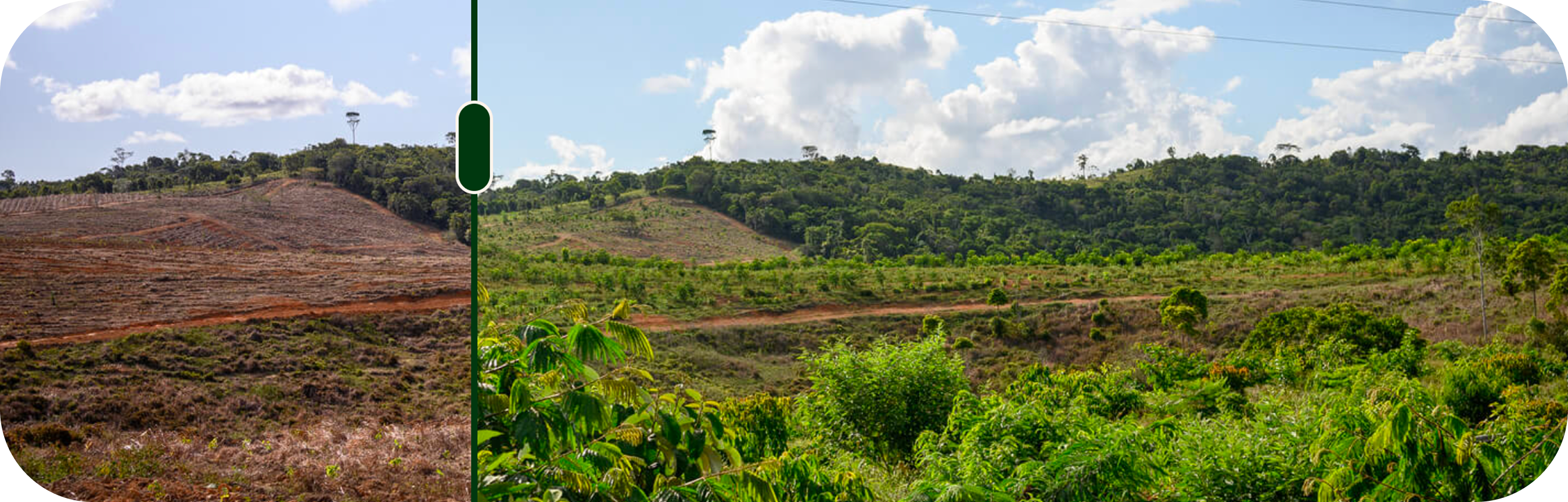
A million hectares. That is the scale of re.green's mission: to restore degraded land across Brazil's Atlantic Forest and Amazon biomes.
At that scale, restoration generates enormous quantities of biomass, thinnings removed to improve forest health, and harvest residues left behind as timber operations mature. This is material that, in most operations, would simply decay.
Could that biomass become a high-value form of carbon removal in the market?
re.green partnered with Residual to find out if this biomass could become a high-value form of carbon removal in the market, commissioning carbon models, financial analysis, and feasibility work needed to find an investable answer.
About re.green
re.green is a Brazilian ecological restoration company working to reverse the loss of tropical forests at landscape scale.
Founded on the premise that restoration and commercial forestry can coexist, re.green partners with landowners and rural producers across Brazil to restore degraded land, planting native species, rebuilding ecological corridors, and generating revenue through sustainable timber and carbon markets.
Securing long-term carbon credit offtakes is central to re.green's commercial model, creating contracted revenue that supports the investment case for large-scale restoration and underpins buyer confidence in project delivery.
Their ambition extends beyond restoration. re.green is building the infrastructure for a new model of land use, one where forests become productive assets and timber operations double as carbon businesses.
The Challenge
re.green's restoration operations produce two streams of biomass: thinnings from early-stage forest management, and harvest residues from mature timber operations. Converting this material into biochar and registering those tonnes as certified carbon credits represented a potential new revenue stream alongside their existing business.
But the path from forest residue to verified carbon credit is not straightforward. re.green's team faced structural questions they couldn't answer internally.
The challenge was compounded by timing. The thinning residues representing re.green's most viable near-term biomass source won't be available at commercial scale until the mid-2030s, when early restoration plantings reach maturity. A credible business case had to model a decade-long ramp-up while remaining grounded enough to inform capital decisions today.
Why Residual
re.green's leadership liked Residual's approach to building carbon and financial models for biochar projects. The depth of that expertise was immediately clear.
Residual brought years of experience in the biochar sector, including direct knowledge of Puro.earth certification pathways, pyrolysis technology trade-offs, and the project economics that determine whether a biochar business case holds up under scrutiny. That kind of specialist knowledge remains genuinely scarce. re.green needed a partner who had already navigated these questions in practice, and whose team combined carbon science, project finance, and technology advisory under one roof.
The Engagement
Over 10 weeks, Residual worked closely with the re.green team to produce three interconnected workstreams.
Residual's Impact
The models didn't just document the business case. In fact, they changed it.
When the financial model was stress-tested against the multi-plant requirement, re.green began to question whether a fixed pyrolysis installation made strategic sense. A fixed plant serving a geographically distributed restoration operation creates a hard logistics ceiling, as farms beyond the viable transport radius fall outside the economics entirely. With two or three plants required, site selection becomes a critical and complex constraint.
That analysis led re.green to explore mobile pyrolysis, which is technology that moves with the restoration operation rather than being anchored in one location and can apply biochar directly to soil during planting. re.green is now in active conversations with technology partners in Brazil to assess this approach.
The engagement also clarified the longer-term circular picture where re.green's own thinning residues feed in-house pyrolysis, converting a forestry waste stream into a certified carbon revenue line that runs alongside the restoration business.
Outcomes at a Glance
The engagement gave re.green three investor-grade deliverables. But beyond the documents, the work produced a strategic reorientation. That discovery directly triggered re.green's pivot from a fixed-plant pilot to a mobile pyrolysis strategy, a shift with meaningful implications for capital requirements, operational complexity, and the timeline to commercialization.